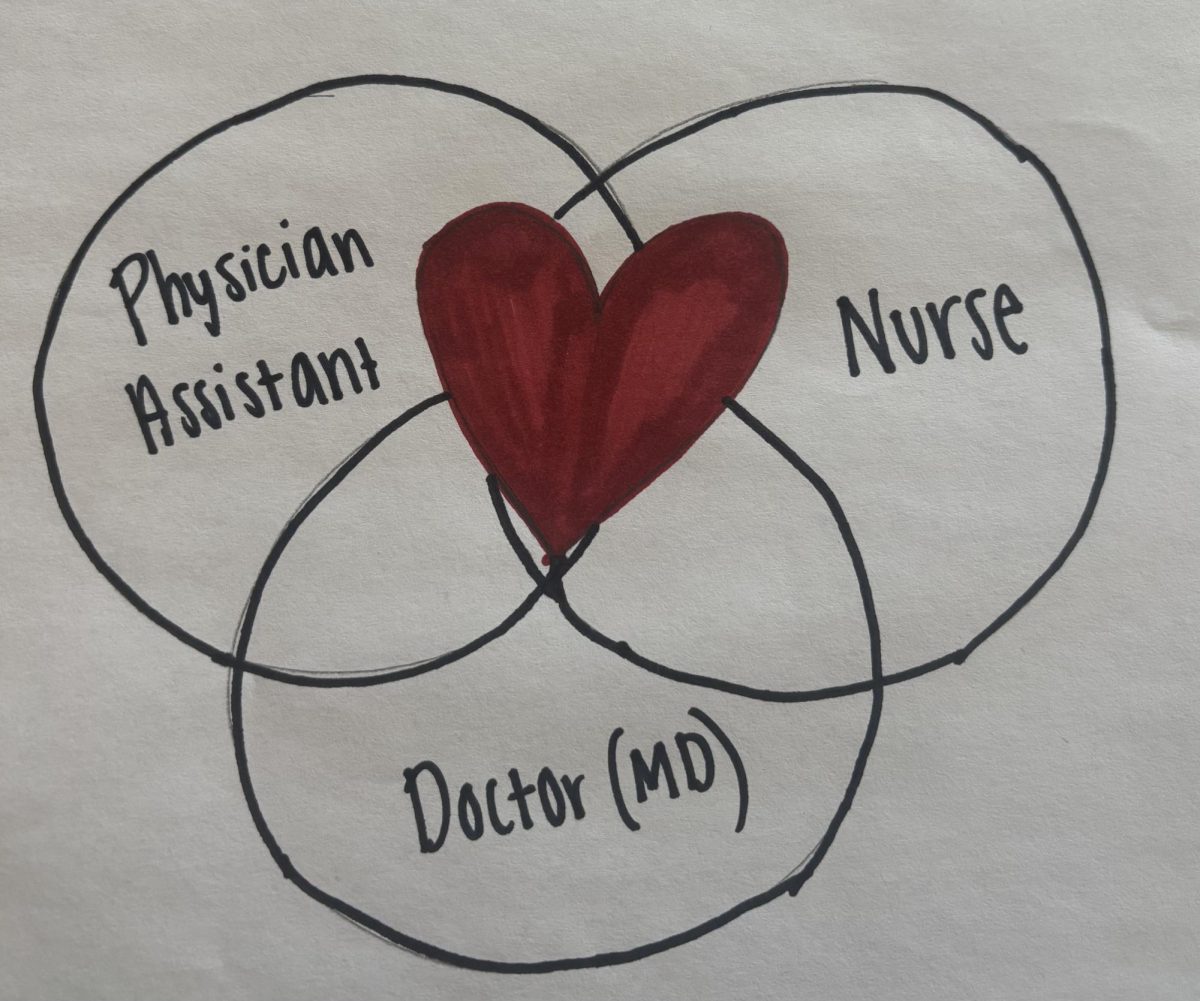
Most patients step into a doctor’s office or hospital focusing on their symptoms, not on the structure of the medical team treating them. However, they may not realize that a team of medical professionals with specific roles and responsibilities and different educational backgrounds is there to help.
To clear the confusion surrounding three of the most common titles–Nurse, Physician Assistant, and Doctor–I decided to talk with three South Shore medical professionals: Celeste Crowley, head of Nurse Practitioners at Brigham & Women’s Harbor Medical, Mark Coyle, an Emergency Department Physician Assistant at South Shore Hospital, and Dr. Benjamin Ryan, a family physician at Scituate Family Practice. Together, they helped paint a clearer picture of how each role contributes to modern healthcare. Through this story, I hope to help others understand the roles and responsibilities that strengthen our South Shore healthcare community.
First, I spoke with Celeste Crowley, 59, about her path to becoming a Nurse Practitioner (NP) and the responsibilities that come with that role. For Crowley, her path wasn’t direct or straightforward, as she began her college career as a pre-med major but ended up as a math teacher. That changed when she began caring for a close friend battling cancer. This experience opened her eyes to a calling she initially recognized in college but never pursued — the field of medicine.
Encouraged to pursue nursing full-time due to her passion for helping others, Crowley enrolled in a three-year fast-track program at Simmons University in Boston. After becoming a registered nurse and working in the Intensive Care Unit (ICU) at South Shore Hospital, she continued her education and became an NP specializing in adult care. Today, she works in Scituate, close to her family and her home, where she can balance her demanding schedule with family and community life.
Crowley loves her work for its variety and purpose: “Every day is truly a different experience,” she said, adding that she is driven to help her patients live healthier lives. But like many healthcare providers, she admits the job has its challenges. Much of her day is spent on documentation and “checking boxes,” which, while crucial, can be tedious. Still, she wouldn’t choose another path. Her advice to future NPs and aspiring nursing students is simple: “Do it only if you’re truly passionate about caring for others and willing to put in the work every day.”
Next, I spoke with Dr. Benjamin Ryan, 51, also of Scituate, whose path was more medically focused from the start, yet still shaped by the twists and turns that so often define a career in healthcare and many other professions. He began his undergraduate studies at Colgate University in Hamilton, NY, where he was drawn to science and problem solving and “fascinated by the human body as a complex machine.”
Initially, Dr. Ryan planned to pursue a PhD and a career in research. But during his freshman year, everything changed after he took a neuroscience course that ignited a new curiosity about the mind and body. Dr. Ryan graduated with a degree in neuroscience and continued to immerse himself in lab work. He even had the opportunity to collaborate with a physician from the National Institute of Health (NIH) on early HIV/AIDS when little was known about the disease or its treatment. That experience, he said, was a powerful motivator in his decision to attend medical school after graduation. He realized that research alone wasn’t enough, and he wanted to work directly with people.
After graduating from Colgate, Dr. Ryan moved home for a year to continue research and apply to medical school. He was accepted to UMass Medical School, later completed a residency in family medicine, and ultimately returned to the South Shore, where he now works at Scituate Family Practice, caring for generations of families. Family medicine, he explained, offered what he was searching for: continuity, connection, and long-term impact. “I’ve known many of my patients for over twenty years,” he said.
Dr. Ryan emphasized that practicing medicine is not for the faint of heart. The work extends well beyond office hours, as he’s “always thinking about patients and what needs to be done.” He also noted that a tough part of the job is delivering bad news to patients, which never seems to get easier. However, he said he doesn’t regret choosing this path, and he made the right choice. His advice to aspiring physicians is raw but encouraging: “The training is long and residency is demanding, but if you truly love your speciality, the reward is just as great.”
Finally, I spoke with Mark Coyle, a Physician Assistant in the Emergency Department (ED) and the Executive Director of Advanced Practice Providers at South Shore Hospital (SSH). This role essentially means he spends 50% of his time at SSH helping younger people get jobs and managing jobs with MDs and PAs, while the other 50% he spends treating patients in the ED. With over 30 years of experience, Coyle has seen the PA role grow from a relatively unknown field to an essential part of modern healthcare. He explained that while PAs share many responsibilities with doctors — examining patients, ordering tests, and creating treatment plans — they work under the supervision of an MD, a relationship he values for the collaboration and support it provides.
Coyle’s path, like many in medicine, was circuitous. He considered attending medical school to become a doctor, but ultimately chose the PA route. What drew him to this career, he said, was the flexibility: unlike doctors, PAs can switch specialties throughout their careers, allowing them to continually evolve within medicine and offering a healthier work-life balance. When asked about a drawback of his job, Coyle paused, clearly searching for an answer. After a moment, he mentioned only the commute—a small inconvenience, he admitted, compared to the job and personal fulfillment.
It was clear how much Coyle values his work and its impact on patients’ lives. Coyle said the most rewarding part of his job is helping people during very vulnerable, scary moments in their lives. His advice to aspiring medical professionals is simple but wise: “Make sure you truly understand the role you’re stepping into, and find the one that really embodies who you are.”
So, what separates the roles of Crowley, Ryan, and Coyle in the medical field? Crowley explained that nurses focus on patient care, such as administering IVs and performing treatments. Nurse practitioners, by contrast, are licensed to diagnose and treat illnesses, and to prescribe medications independently in many states, allowing them to manage a patient’s care more autonomously. Physician assistants also diagnose and treat, but they practice under a supervising physician and can switch specialties throughout their careers, making it a very diverse career path. Medical doctors, Dr. Ryan noted, complete the most extensive training, assume ultimate responsibility for medical decision-making, and usually specialize in particular areas.
Despite differences in responsibilities and training, each role supports the same mission—helping patients heal.
My conversations with these medical professionals helped me understand that modern healthcare is not a hierarchy, but a team. Nurses, PAs, and doctors bring distinct training and perspectives to their patients, but they share a common purpose. As Dr. Ryan put it, “We all work together to take care of people.” For patients, that may be the only distinction that truly matters.