To say the least, music has changed drastically since its beginning. With the changes, however, it often seems impossible to pinpoint where exactly new ideas come from. Obviously, technology and its advancements can be largely credited for many of these shifts. Nevertheless, the way people use these advancements is truly what creates the music we think of as influential.
Many people looking at today’s music industry think music as a whole has gone south. Some argue that the use of Musical Instrument Digital Interface (MIDI), and especially the reliance on it, limits a song’s humanism or authenticity through its sole purpose: to replicate instruments without the process of actually playing or practicing them.
MIDIs and other digital sounds show up in almost all music you hear today. Autotune adds intonation to a singer’s voice, and synthetic instruments replicate those that others have to learn. The added ease of producing and releasing music in today’s digital climate is just one example of how the skill required to release music is only going down. Nevertheless, it is expanding the range of what is possible in music.
According to SHS senior Aidan Campbell, a singer, songwriter, and multi-instrumentalist for many different music groups, with the new technology, “there is a lot of new involvement in the music industry, like electronic music, and a lot of new opportunities for younger audiences as well.” From his point of view, these advancements are a new outlet and a way to be creative with music. However, he quickly followed up by stating, “Those are the good changes, but the bad changes, like AI,… (are) sort of taking over an aspect of the music industry,” a very scary thought for a musician like him.
Some may look at this productivity as better for the artists and the industry, but from the point of view of one concerned with musicality, shouldn’t a song about pain and emotion take pain and emotion to write? And what is the line that separates popular music from efficient music? As SHS junior Bennett Brandolini put it, “Music is based on human creativity,” arguing that music is not music if created by a robot.
Now, MIDI and effects aren’t necessarily negative; many of the emotional songs listeners hear are driven by and incorporate many technological enhancements. Since we live in an age of technology, it makes sense, literally and metaphorically, that our emotions are tinged with an undertone of technology. Legends like Janet Jackson, Queen, Depeche Mode, Bonnie Raitt, and many more are all marked by both their emotional writing and their use of synths and technology in their songs. Not to mention the effects applied directly to instruments, as seen in the works of Jimi Hendrix, Billy Joel, Radiohead, and Jeff Buckley, which only amplify and emotionalize their sound.
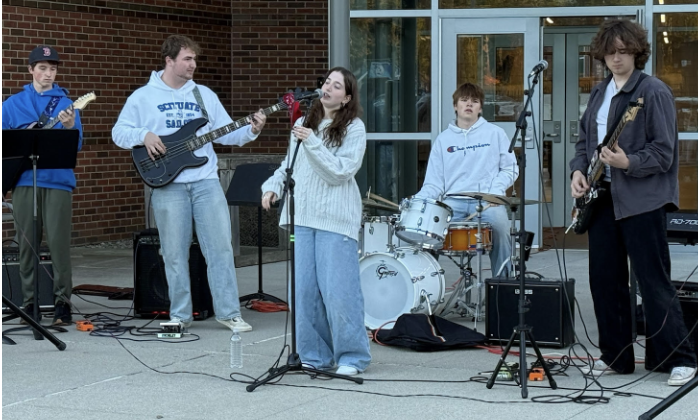
With today’s rise in pop and pop-rap music (music created with the intention of being popular), the music industry as a whole shifts from one subgenre of pop to another every couple of months as listeners grow bored with the current sound. While this draws people, especially adolescents, in and excites them with the constant shift in releases and mood, some find this chasing boring and prefer older artists that are familiar, and (to these listeners) often more emotional. As SHS sophomore Piper Levirne, lead singer of the independent high-school band REVEL, put it, “Currently, trending music is usually a bit too generic or pop-y for my taste. Still, there’s good music being made even if it is not the most popular.” This might explain why older artists who incorporate both technology and emotion into their writing are coming back — even in today’s competitive industry.
For people less concerned with the music industry’s economic factors and more with the music being produced from it, this is a great concern. Jacob Kenneway, SHS senior bassist for the band REVEL, said when choosing songs to play, he thinks “complexity of the song is very important… (and the) variation and uniqueness… make the song interesting to the listener.” Will Larson, SHS senior percussionist, singer, actor, and music writer, explained, “People put out albums, and almost every song kind of just sounds the same.”
Nevertheless, true creative music is not lost; it is more a question of what you enjoy and how you define creativity. Do you prefer the organic, but less technological sound, of earlier generations, or do you like the beat and synths of today more than the raw human nature of songs past?
It is all a matter of preference.